
Table of Contents
- Why Healthcare CFOs Are Comparing Sage Intacct vs Sage 50 Right Now
- What Is Sage 50? Platform Overview and Intended Use Case
- What Is Sage Intacct? A Cloud-Native ERP Designed for Multi-Entity Complexity
- Sage Intacct vs Sage 50: A Direct Feature Comparison for Healthcare Organizations
- Multi-Entity Reporting and Automated Intercompany Eliminations
- EMR and EHR Integration: Epic, Athenahealth, eClinicalWorks, and More
- Provider-Level P&L and Physician Compensation Reporting
- Service Line, Location, and Payer Mix Reporting
- AP Automation and Accounts Payable Workflow
- Month-End Close Acceleration
- Dashboards, KPI Reporting, and Real-Time Financial Visibility
- Mobile App, Single Sign-On, and User Access Controls
- HIPAA-Aware Design and Data Security
- Scalability: Handling Acquisitions, New Entities, and Rapid Growth
- Total Cost of Ownership and ROI: Sage Intacct vs Sage 50
- Which Healthcare Organizations Are the Right Fit for Sage Intacct?
- The Verdict: Sage Intacct Wins for Healthcare Finance at Scale
- How to Transition from Sage 50 to Sage Intacct: A Structured Methodology
- The 5-Phase Finance Transformation Roadmap: Discover, Design, Decide, Deliver, Guide
- What to Expect During Data Migration and Chart of Accounts Redesign
- Next Steps: Start with a Technology ROI Assessment
- FAQs
Why Healthcare CFOs Are Comparing Sage Intacct vs Sage 50 Right Now
When healthcare finance teams start comparing Sage Intacct vs Sage 50, it is usually not because someone woke up excited to evaluate accounting software. It is because the close is taking too long, provider reporting is too manual, spreadsheets are carrying too much risk, and leadership is asking questions the current system cannot answer without a finance person disappearing into Excel for three days.
Nobody holds a ceremony for it.
There is no dramatic system failure. No flashing red light. No finance team member walks into the CFO’s office and says, “Congratulations, we have officially outgrown our accounting platform.”
Instead, it shows up in small, painful ways.
The close takes longer than it should. Reports need three exports, four spreadsheets, and one person named Linda who knows where all the bodies are buried. Provider profitability takes days to calculate. Location reporting is inconsistent. Intercompany entries are held together with manual journal entries and hope. The EMR knows more about the business than the accounting system does.
That is usually the moment healthcare CFOs start comparing Sage 50 and Sage Intacct.
Not because Sage 50 is bad software.
It is not.
Sage 50 can be a perfectly reasonable accounting system for a smaller, simpler business. But healthcare finance does not stay simple for long. Add multiple locations, provider compensation models, payer mix reporting, ASC ownership structures, management service organizations, acquisitions, shared overhead, and EMR data, and suddenly the old system is not just inconvenient.
It becomes a constraint.
And in healthcare, financial constraints do not stay inside finance. They leak into physician trust, leadership decisions, cash flow, staffing, board reporting, and growth.
That is why this comparison matters.
This is not just Sage Intacct versus Sage 50.
This is simple accounting software versus a finance platform built for complexity.
The Signs You've Outgrown Your Current Accounting System
Most healthcare organizations do not outgrow their accounting software all at once. They outgrow it one workaround at a time.
At first, the workaround feels harmless.
“We’ll just export this to Excel.”
“We’ll track that outside the system.”
“We’ll manually allocate those expenses at month end.”
“We’ll build a provider report in a spreadsheet for now.”
Then “for now” becomes the process.
The warning signs are usually obvious, but because the team is busy, they get normalized.
The month-end close depends on manual reconciliations. Consolidated reporting takes too long. There is no easy way to see profitability by location, provider, service line, or payer. Reports are static instead of interactive. Leadership asks good questions, but finance cannot answer them without rebuilding the data. The system cannot easily handle new entities, acquisitions, or ownership structures.
And the biggest warning sign?
People stop trusting the numbers.
That is the part many software comparisons miss. They focus on features. But the real issue is confidence.
When physician owners do not trust their P&L, leadership loses one of its most useful tools. When administrators cannot see margin by location, they manage from instinct. When finance spends more time assembling reports than analyzing them, the accounting department becomes a reporting factory instead of a decision support function.
That is not a people problem.
That is a system design problem.
What Is Sage 50? Platform Overview and Intended Use Case
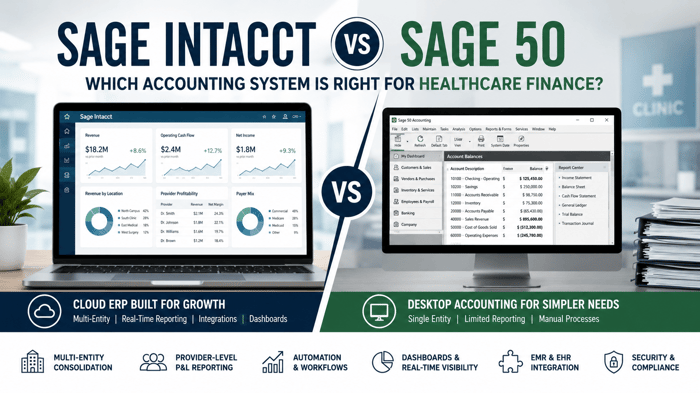
Sage 50 is a desktop-based accounting system designed primarily for small businesses with straightforward accounting needs.
It handles the basics well enough for many organizations. General ledger. Accounts payable. Accounts receivable. Invoicing. Bank reconciliations. Standard financial statements. Basic reporting.
For a single-entity business with a relatively simple chart of accounts, limited users, and no need for complex operational reporting, Sage 50 may be enough.
That is the key phrase.
May be enough.
Sage 50 was not designed to be the financial backbone for a multi-location healthcare organization with provider-level profitability reporting, EMR integration, intercompany eliminations, complex approvals, payer mix analysis, and real-time dashboards.
It was built for accounting.
Not healthcare finance transformation.
That distinction matters.
Sage 50's Core Features and Functionality and Where It Hits The Wall
Healthcare finance is messy.
Revenue does not always behave cleanly. Expenses are shared across locations and providers. Compensation models vary by specialty, ownership structure, productivity, collections, wRVUs, quality metrics, or some lovely combination that only makes sense after three cups of coffee and a legal agreement.
Sage 50 struggles because it is structurally limited.
It is not built for modern multi-entity reporting. It does not provide the kind of dimensional accounting healthcare organizations need. It is not designed for deep EMR or EHR integration. It does not give finance teams flexible dashboards for provider, location, payer, or service-line visibility.
So the finance team fills the gaps manually.
They build spreadsheet models. They maintain separate schedules. They create custom reports outside the system. They rely on exports, pivot tables, and institutional memory.
That may work when the organization is small.
But as the organization grows, those manual processes become fragile.
One new clinic. One new acquisition. One new compensation model. One key employee leaves. Suddenly the system is not supporting the organization. The organization is supporting the system.
That is backward.
What Is Sage Intacct? A Cloud-Native ERP Designed for Multi-Entity Complexity
Sage Intacct is a cloud-native ERP platform built for more complex organizations, especially those that need multi-entity reporting, dimensional accounting, workflow automation, dashboards, and integrations.
For healthcare organizations, that difference is significant.
Sage Intacct is not just a place to record transactions. It can become the financial operating layer that connects accounting data, operational data, entity structures, locations, providers, service lines, and leadership reporting.
The major shift is this:
Sage 50 is primarily a small-business accounting system.
Sage Intacct is a financial management platform.
That difference shows up in how reports are built, how approvals flow, how entities consolidate, how dashboards are created, how data is integrated, and how leadership uses the numbers.
Sage Intacct's Core Modules Relevant to Healthcare
Healthcare organizations powered by Sage Intacct will be using the following modules at a minimum:
- General Ledger
- Budgets
- Reporting
- Cash Management
- Accounts Payable
- Reports
- Dashboards
But it is extremely important to consider usage of the following additional modules to achieve Freedom of Clarity, Freedom of Efficiency, and Freedom of Time:
- Dynamic Allocations
- AP Bill Automation
- Supplies Management
- Spend Management
- Purchasing
- Platform Services
- Interactive Custom Report Writer
The General Ledger, Chart of Accounts, and Dimensional Accounting Engine
This is where Sage Intacct starts to separate itself.
In a traditional accounting system, organizations often try to force reporting needs into the chart of accounts.
Want to report by location? Add more account numbers.
Want to report by provider? Add more account numbers.
Want to report by service line? Add more account numbers.
Congratulations. You now have a chart of accounts that looks like it was assembled during a hostage negotiation.
Sage Intacct solves this differently through dimensional accounting.
Instead of creating endless account codes, you keep the chart of accounts cleaner and use dimensions to tag transactions by meaningful business attributes.
For healthcare, those dimensions might include:
Provider.
Location.
Department.
Entity.
Service line.
Payer.
Procedure category.
Grant.
Contract.
Class.
The goal is simple: build a stable accounting backbone and a flexible reporting layer.
That is the difference between a chart of accounts that supports the business and a chart of accounts that slowly turns into a junk drawer.
With dimensions, healthcare CFOs can analyze the business in ways that actually match how the organization operates. Provider profitability. Location performance. Service-line margin. Payer mix. Shared overhead. Compensation components.
And they can do it without rebuilding the entire general ledger every time leadership asks a better question.
How Sage Intacct's API and Integration Layer Works
One of the most important realities in healthcare finance is this:
Your EMR often knows your business better than your accounting system.
The EMR knows patient volumes, encounters, charges, payments, adjustments, payer activity, provider activity, and operational detail. But if that data stays trapped in the clinical or billing system, finance is forced to recreate the story manually.
That is where Sage Intacct’s integration capabilities matter.
Sage Intacct’s API architecture allows organizations to connect financial and operational data through middleware tools like Workato, Boomi, MuleSoft, or custom integration layers.
That does not mean every healthcare organization needs a massive integration project on day one.
It means the system has the architecture to grow into one.
For healthcare CFOs, this is a strategic distinction. You are not just buying software for today’s close. You are choosing whether your finance stack can eventually support automated data flows between the EMR, billing systems, payroll, AP automation, banking, dashboards, and accounting.
Sage 50 is not built for that world.
Sage Intacct is.
Sage Intacct vs Sage 50: A Direct Feature Comparison for Healthcare Organizations
When evaluating Sage Intacct vs Sage 50, healthcare CFOs should not start with feature checklists. They should start with complexity.
Sage 50 works when the business is relatively simple.
Sage Intacct becomes the better fit when complexity is no longer optional.
Multi-Entity Reporting and Automated Intercompany Eliminations
Sage 50 can become cumbersome when healthcare organizations need reporting across multiple legal entities, tax IDs, locations, or ownership structures.
That matters because many healthcare organizations are not one clean entity with one clean P&L.
They have management companies. Real estate entities. ASC ownership structures. Multiple locations. Different physician owners. Different departments. Sometimes entities are added through acquisition, not elegant planning.
Sage Intacct is designed for multi-entity environments. It can support consolidated reporting, automated intercompany activity, entity-level visibility, and reporting structures that allow CFOs to see both the details and the rollup.
Sage 50 usually pushes that work outside the system.
And once consolidation lives outside the system, finance inherits more risk.
EMR and EHR Integration: Epic, Athenahealth, eClinicalWorks, and More
Healthcare organizations often depend on systems like Epic, Athenahealth, eClinicalWorks, NextGen, ModMed, or other practice management and billing platforms.
The question is not whether those systems matter.
They obviously do.
The question is whether the accounting system can receive, organize, and report on financial and operational data from those systems in a meaningful way.
Sage Intacct’s API-driven architecture gives healthcare organizations a path toward EMR-to-ERP integration. That can include revenue, payments, adjustments, volumes, provider activity, location data, or other operational metrics.
Sage 50 is not designed for that level of integration.
So the gap gets filled manually.
And manual data movement is where errors, delays, and arguments are born.
Provider-Level P&L and Physician Compensation Reporting
This is one of the biggest healthcare use cases.
Physician-owned groups often need to calculate compensation based on a blend of productivity, collections, expenses, shared overhead, ownership, quality incentives, wRVUs, or other custom rules.
Trying to manage that in Sage 50 usually means building the real model outside the accounting system.
That can work temporarily. But it creates a trust problem.
Physicians do not just want the number.
They want to understand the number.
They want to know how revenue was assigned, how expenses were allocated, how shared costs were handled, and why their compensation changed.
Sage Intacct can support this through dimensions, allocations, dashboards, and structured reporting. With the right design, finance teams can create provider-level P&Ls and compensation reporting that is more transparent, more repeatable, and easier to audit.
That does not eliminate complexity.
It makes the complexity manageable.
Service Line, Location, and Payer Mix Reporting
Healthcare leaders need to understand where margin is actually coming from.
Not just total revenue.
Not just total expenses.
They need to know which locations are performing, which service lines are profitable, how payer mix is affecting margins, and whether growth is actually improving the business.
Sage 50 is not built for this kind of flexible, dimensional reporting.
Sage Intacct is.
This is where CFOs move from accounting reports to management intelligence.
A trial balance tells you what happened.
Dimensional reporting helps explain why it happened.
That is the difference.
AP Automation and Accounts Payable Workflow
Accounts payable is another area where the difference becomes obvious.
In smaller organizations, AP can survive with manual invoice entry, email approvals, paper processes, and vendor files that live in a few different places.
In growing healthcare organizations, that gets ugly fast.
Multiple locations. Department approvals. Physician approvals. Capital purchases. Medical supplies. Vendor compliance. Recurring invoices. Payment timing. Cash visibility.
Sage Intacct can support automated AP workflows, approval routing, vendor management, electronic payments, and stronger controls.
Sage 50 is much more limited.
The issue is not just efficiency. It is control.
A strong AP workflow reduces bottlenecks, improves visibility, and gives finance better command over cash and obligations.
Month-End Close Acceleration
The month-end close is one of the clearest indicators of system maturity.
If the close depends on manual exports, offline schedules, spreadsheet allocations, and heroic effort, the accounting system is not doing enough of the work.
Sage Intacct can help accelerate the close through automation, recurring entries, allocations, workflows, real-time reporting, and cleaner entity structures.
Sage 50 usually leaves more of that burden on the finance team.
A faster close is not just an accounting win.
It changes decision-making.
If leadership gets clean financials three weeks after month end, they are managing the past. If they get them quickly, with meaningful operational detail, they can actually manage the business.
Dashboards, KPI Reporting, and Real-Time Financial Visibility
Static reports have their place.
But healthcare leadership increasingly needs real-time visibility.
CFOs need dashboards. Administrators need location performance. Physician owners need provider-level clarity. Operations needs volume and margin trends. Leadership needs KPI reporting that does not require a monthly spreadsheet ritual.
Sage Intacct provides role-based dashboards and reporting tools that can be designed around the needs of finance, operations, executives, and owners.
Sage 50’s reporting is more static and limited.
That matters because the CFO’s job has changed.
It is no longer enough to produce financial statements.
Modern healthcare CFOs are expected to explain the business.
Mobile App, Single Sign-On, and User Access Controls
Cloud access, single sign-on, role-based permissions, and audit trails are no longer “nice to have” features.
They are part of responsible system design.
Sage Intacct is built for a modern cloud environment with stronger access controls, approval workflows, and user management.
Sage 50 is desktop-first and more limited in this area.
For healthcare organizations, this matters because access should be intentional. Not everyone needs to see everything. Approvers need the right workflows. Finance needs auditability. Leadership needs visibility without compromising control.
HIPAA-Aware Design and Data Security
A quick but important clarification: accounting systems are not EMRs.
You should not casually push protected health information into your ERP and call it innovation.
That is how smart people create expensive problems.
But healthcare organizations do need HIPAA-aware workflow design. That means thoughtful data architecture, appropriate access controls, audit trails, careful integration design, and discipline around what data belongs in the financial system.
Sage Intacct provides a better foundation for secure, controlled, auditable finance workflows than Sage 50.
The key is implementation design.
The software matters. But the design matters more.
Scalability: Handling Acquisitions, New Entities, and Rapid Growth
Growth breaks weak systems.
A healthcare organization may add a new location, acquire a practice, launch a new service line, create a new entity, or restructure ownership.
In Sage 50, those changes can create significant reporting and process strain.
In Sage Intacct, the system can be designed to support growth more cleanly through entities, dimensions, workflows, reporting structures, and integrations.
That is one of the strongest arguments for Sage Intacct.
You are not only solving today’s reporting problems.
You are building a finance platform that can survive the next version of the business.
Total Cost of Ownership and ROI: Sage Intacct vs Sage 50
The business case for Sage Intacct vs Sage 50 comes down to whether the cost of the new system is lower than the cost of continuing to operate with manual workarounds.
They compare subscription cost.
That is not a business case.
The real cost of an accounting system includes licensing, implementation, training, integrations, support, internal labor, manual workarounds, delayed reporting, errors, rework, turnover risk, and missed decisions.
Sage 50 may look cheaper on the surface.
But if the finance team is spending dozens or hundreds of hours every month compensating for system limitations, that cost is real.
It just does not show up on the software invoice.
Sage Intacct requires a larger investment. No question.
But the ROI case should be evaluated against the cost of staying where you are.
How much time is lost in the close?
How much reporting is rebuilt manually?
How many decisions are delayed because leadership does not trust the numbers?
How much growth is harder because the system cannot scale?
How much institutional knowledge sits in one or two employees’ heads?
A CFO-defensible business case does not say, “We want better software.”
It says, “Here is the measurable financial and operational cost of our current process, and here is how the new system reduces that cost.”
That is a very different conversation.
Key ROI Drivers: Close Acceleration, Headcount Avoidance, DSO Recovery
There are three major ROI drivers healthcare CFOs should quantify.
First, close acceleration.
If Sage Intacct helps reduce the close from fifteen business days to seven, that creates capacity and improves decision timing. Finance can spend less time assembling the past and more time advising on the future.
Second, headcount avoidance.
This does not always mean cutting staff. In fact, that is usually not the best framing.
The better framing is this: can the organization grow without adding finance headcount at the same rate?
If automation, workflows, integrations, and reporting tools allow the team to support more locations, entities, providers, or transactions without adding another full-time person, that is meaningful ROI.
Third, cash flow improvement.
Better visibility into AR, payer mix, revenue trends, denials, collections, and operational drivers can support faster action. If finance and operations can spot problems sooner, they can respond sooner.
That may affect DSO, reimbursement visibility, working capital, and leadership accountability.
These are the kinds of ROI drivers that matter to a CFO, CEO, board, or physician ownership group.
Not “the dashboard looks nice.”
Nice dashboards are fine.
Useful dashboards are better.
Which Healthcare Organizations Are the Right Fit for Sage Intacct?
Sage Intacct is not necessary for every healthcare organization.
A small, single-location practice with simple accounting needs may not need it yet.
But once complexity enters the picture, the fit becomes much stronger.
The best candidates usually have some combination of multiple entities, multiple locations, provider-level reporting needs, complex compensation models, acquisition activity, shared overhead, payer mix analysis, AP workflow challenges, or a need to integrate financial and operational data.
Physician Groups, MSOs, and Multi-Entity Practices
Physician groups and MSOs are often excellent fits for Sage Intacct.
They tend to have complicated ownership structures, multiple tax IDs, shared services, provider compensation models, and a need for transparent reporting.
The CFO is not just trying to close the books.
They are trying to produce numbers that owners believe.
That is a very different standard.
Post-Acute Providers and Ambulatory Surgery Centers
Post-acute providers and ASCs often need strong location-level reporting, expense control, payer visibility, and AP automation.
Margins can be tight. Labor and supply costs matter. Payer mix matters. Volume matters.
Sage Intacct gives finance teams a better way to connect operational reality to financial performance.
Hospitals and Clinic Networks Needing EMR-to-ERP Connectivity
Hospitals and clinic networks often have deeper system complexity, larger transaction volumes, and more demanding reporting needs.
For these organizations, EMR-to-ERP connectivity becomes more important. Finance needs a way to connect accounting structure with operational data flows.
Sage Intacct is far better positioned for that environment than Sage 50.
The Verdict: Sage Intacct Wins for Healthcare Finance at Scale
The verdict on Sage Intacct vs Sage 50 is straightforward: Sage 50 may work for simple accounting, but Sage Intacct is the better fit for healthcare organizations with multi-entity, provider-level, and integration complexity.
If your healthcare organization is simple, single-entity, and does not need advanced reporting, Sage 50 may be enough.
But if you are managing multiple entities, multiple locations, provider compensation, service-line reporting, payer mix analysis, intercompany activity, AP workflows, dashboards, or EMR integration, Sage Intacct is the better fit.
Not because it is shinier.
Because it is built for the complexity you already have, or the complexity you are about to have.
And that is the point.
The right accounting system should not force your finance team to build the real reporting environment outside the system.
It should become the foundation that makes better reporting, better controls, better visibility, and better decisions possible.
How to Transition from Sage 50 to Sage Intacct: A Structured Methodology
A Sage 50 to Sage Intacct transition should not start with software configuration.
That is a mistake.
It should start with business design.
What does leadership need to see?
How should the organization report profitability?
What dimensions matter?
Which entities need consolidation?
How should shared costs be allocated?
What data should come from the EMR?
What workflows need approval?
What reports should exist on day one?
What can wait until phase two?
This is where many implementations go sideways. The team jumps into setup before agreeing on the financial model.
That is how you end up recreating the old system inside the new one.
And that is a very expensive way to stay stuck.
The 5-Phase Finance Transformation Roadmap: Discover, Design, Decide, Deliver, Guide
A stronger implementation follows a structured methodology.
At Campbell Technology Advisors, we think about this through a 360-degree Technology Roadmap: Discover, Design, Decide, Deliver, Guide.
Discover
This is where the real problems are uncovered.
Not just “we need better reporting.”
Better reporting for whom?
The CFO? The controller? The practice administrator? Physician owners? Department managers? Board members?
Discovery should identify the pain points, current workflows, reporting gaps, manual processes, integration needs, and decision-making problems.
This phase is about understanding how the business actually runs, not how the org chart says it runs.
Design
Design is where the future-state finance architecture takes shape.
This includes the chart of accounts, dimensions, entities, workflows, reporting structure, integrations, permissions, dashboards, and close process.
This is the most important phase.
Bad design creates long-term pain.
Good design creates leverage.
Decide
This is where the organization aligns on scope, priorities, budget, timing, and implementation sequence.
Not everything needs to happen at once.
Some organizations should start with core financials and reporting. Others may need AP automation early. Others may need physician compensation modeling or EMR integration as a strategic priority.
The key is making intentional decisions instead of trying to boil the ocean.
Healthcare already has enough boiling oceans.
Deliver
This is the implementation phase.
Configuration. Data migration. Testing. Training. Workflow setup. Report building. Dashboard creation. Integration work. Go-live support.
The goal is not merely to “turn on” Sage Intacct.
The goal is to deliver a working finance platform that supports the way the organization needs to operate.
Guide
Go-live is not the finish line.
It is the beginning of optimization.
Once users are in the system, new opportunities appear. Reports improve. Dashboards evolve. Workflows get refined. Integrations expand. Leadership asks better questions.
That is a good thing.
A strong system should grow with the organization.
What to Expect During Data Migration and Chart of Accounts Redesign
The transition from Sage 50 to Sage Intacct is also an opportunity to clean up the financial foundation.
That usually means rethinking the chart of accounts.
Many organizations discover that their current chart of accounts is carrying years of workarounds. Account numbers were added for reporting needs that should have been handled through dimensions. Old accounts are still active. Naming conventions are inconsistent. Departments, locations, providers, and service lines may be embedded in account codes.
Sage Intacct gives you the chance to separate the accounting backbone from the reporting layer.
That does not mean making the chart of accounts overly simple.
It means making it intentional.
Historical data migration also needs careful planning. Some organizations migrate summary balances. Others migrate transaction history. Some keep legacy history accessible in Sage 50 while moving forward with cleaner data in Sage Intacct.
The right approach depends on reporting needs, audit requirements, budget, timing, and operational priorities.
The worst approach is pretending data migration is just a technical task.
It is not.
It is an accounting, reporting, and leadership decision.
Post-Implementation Optimization and Advisory Support
The organizations that get the most value from Sage Intacct do not treat implementation as a one-time event.
They treat it as the beginning of a better operating model.
After go-live, there are usually opportunities to improve dashboards, refine allocations, add workflows, automate AP, connect outside systems, improve reporting packages, and build better management views.
This is where advisory support matters.
Because the software will not automatically know how your physician compensation model works.
It will not automatically understand which profitability views matter.
It will not automatically decide how your EMR data should connect to your financial reporting.
Those decisions require accounting judgment, systems experience, and healthcare finance context.
That is the difference between installing software and designing a financial operating system.
Next Steps: Start with a Technology ROI Assessment
If your finance team is still making Sage 50 work through spreadsheets, manual consolidations, offline provider reports, and disconnected operational data, the real question is not whether you can survive another month.
You probably can.
Finance teams are very good at surviving.
The better question is whether the current system can support the organization you are becoming.
If the answer is no, start with a Technology ROI Assessment here:
https://www.campbelltechnologyadvisors.com/roi-calculator/
Quantify the cost of the current process. Measure the time lost in the close. Identify the manual reporting burden. Estimate the hidden cost of workarounds. Map the reporting needs leadership actually has. Then build a CFO-defensible business case for what comes next.
A thoughtful Sage Intacct vs Sage 50 evaluation should help your team decide whether your current accounting system can support the healthcare organization you are becoming.
Because the goal is not just to buy Sage Intacct.
The goal is to build a finance platform that gives healthcare leaders better visibility, stronger controls, faster answers, and numbers people actually trust.
FAQs
What is the main difference between Sage Intacct and Sage 50?
Sage 50 is a desktop accounting system built for smaller, simpler businesses. Sage Intacct is a cloud-based financial management platform built for more complex organizations that need multi-entity reporting, automation, dashboards, integrations, and stronger financial visibility.
For healthcare organizations, the difference becomes obvious when the finance team needs reporting by provider, location, service line, payer, entity, or ownership group.
Is Sage 50 good enough for a healthcare practice?
Sage 50 can work for a small, single-entity healthcare practice with basic accounting needs. But it usually starts to break down when the organization adds multiple locations, providers, entities, compensation models, or reporting requirements.
Once the team is relying on spreadsheets for consolidations, provider P&Ls, or month-end reporting, it is usually a sign the practice has outgrown Sage 50.
Why is Sage Intacct better for healthcare finance teams?
Sage Intacct is better suited for healthcare finance teams because it supports dimensional reporting, multi-entity consolidation, automated workflows, dashboards, and integrations with other systems.
That means CFOs and controllers can report on the business the way healthcare actually operates: by provider, location, department, service line, payer mix, and entity, without creating a bloated chart of accounts.
Can Sage Intacct integrate with EMR or EHR systems?
Yes. Sage Intacct has API capabilities that can support integration with EMR, EHR, billing, payroll, banking, and other operational systems through middleware or custom integration work.
For healthcare organizations, this can help connect operational data with financial reporting, reducing manual exports and giving leadership better visibility into revenue, volumes, payments, adjustments, and profitability.
When should a healthcare organization move from Sage 50 to Sage Intacct?
A healthcare organization should consider moving from Sage 50 to Sage Intacct when reporting becomes too manual, the close takes too long, leadership lacks real-time visibility, or finance cannot easily report by entity, provider, location, service line, or payer.
The best time to evaluate the move is before growth makes the current process painful. If acquisitions, new locations, physician compensation complexity, or EMR integration are on the roadmap, Sage Intacct is usually the stronger long-term platform.