
Table of Contents
- Choosing Between Finance-First Accounting Software and General ERP
- What Finance-First Accounting Software Means
- What a General ERP Is Built to Do
- The Real Question Is Fit
- Reporting Should Drive the Decision
- Month-End Close Should Not Rely on Manual Follow-Up
- Visibility Matters More as You Grow
- Scalability Is More Than Adding Users
- Implementation Should Start With Process
- Where Sage Intacct Fits
- Questions to Ask Before Choosing a System
- The Bottom Line
- FAQs
Choosing Between Finance-First Accounting Software and General ERP
Finance-first accounting software can be a strong fit for growing organizations that need better reporting, cleaner close processes, and stronger financial visibility. When teams start evaluating new accounting systems, the conversation often turns into a comparison between two paths: a finance-first accounting platform or a broader general ERP system.
Both can have a place. The right answer depends on the organization’s size, complexity, industry, reporting needs, operational structure, and long-term goals.
From a CPA’s perspective, the decision should not start with the software brand. It should start with how the organization needs to operate.
A system may look impressive during a demo, but the real question is whether it helps the finance team produce better information with less friction. That means looking closely at reporting, controls, visibility, scalability, workflows, and the team’s ability to close the books accurately and on time.
That is where a finance-first accounting platform can make a meaningful difference.
What Finance-First Accounting Software Means
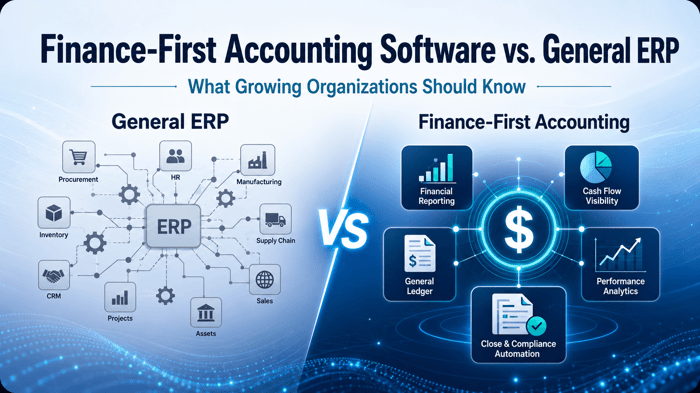
Finance-first accounting software is built around the needs of accounting and finance teams.
That usually includes general ledger, accounts payable, accounts receivable, cash management, financial reporting, consolidations, approvals, budgeting, forecasting, and month-end close.
The focus is not only on recording transactions. The focus is on helping the finance team manage financial data, report on performance, support stronger controls, and give leadership a clearer view of the organization.
For growing organizations, that matters.
New entities are added. More locations come online. Reporting requirements expand. Leaders want faster answers. Boards, lenders, and stakeholders expect better financial visibility. What worked a few years ago can quickly become too manual.
When finance teams begin spending more time exporting, cleaning, and rebuilding information outside the system, it may be a sign that the current platform is no longer supporting the organization well enough.
What a General ERP Is Built to Do
A general ERP system is usually built to support multiple areas of the business in one platform.
That may include finance, operations, inventory, purchasing, manufacturing, project management, supply chain, customer management, human resources, or other business functions.
For some organizations, that broader structure makes sense. A business with complex inventory, production, warehouse, or supply chain needs may need a system that connects many operational areas.
The important point is that broader does not always mean better for finance.
In some ERP systems, finance is one part of a much larger platform. That can work well when the financial functionality is strong enough. But it can also create challenges if reporting, consolidations, approvals, or close processes require extra configuration, outside tools, or manual workarounds.
Finance leaders should look carefully at how deep the accounting functionality really is, not just how many features the system includes.
The Real Question Is Fit
This decision should not be framed as one system type always being better than another.
The real question is fit.
What does the organization need most right now?
If the biggest challenges are financial reporting, month-end close, manual consolidations, approval workflows, budget visibility, and leadership dashboards, then a finance-first platform may be the better starting point.
If the biggest challenges are tied to manufacturing, inventory, production, warehouse operations, or supply chain, then a broader ERP evaluation may be needed.
Many organizations fall somewhere in the middle. That is why the process should start with a roadmap, not a product demo.
Before comparing systems, leadership should understand the current process, the gaps in reporting, the amount of manual work being done, and what the finance team needs to support future growth.
Reporting Should Drive the Decision
Reporting is one of the clearest ways to evaluate whether a system is right for the finance team.
In many growing organizations, reporting depends too heavily on spreadsheets. The finance team exports data, cleans it, combines it, and rebuilds reports for leadership, boards, lenders, or department managers.
That process may work for a while, but it becomes harder to manage as the organization grows.
A finance-first accounting platform should make reporting easier to manage inside the system. The goal is to build reports around how the organization actually operates.
That may mean reporting by entity, department, location, fund, program, project, provider, customer, or service line.
When reporting is structured correctly, the finance team can spend less time preparing the numbers and more time explaining what the numbers mean.
Month-End Close Should Not Rely on Manual Follow-Up
A slow close process is often a sign that the system and process are not aligned.
If the finance team has to chase approvals, reconcile data manually, check spreadsheets, or wait for information from different systems, month-end close becomes harder than it needs to be.
A stronger accounting system should support a more organized close process. It should help the team see what is complete, what still needs review, and where delays are happening.
This matters because delayed financial information limits decision-making.
Leadership cannot respond quickly if the numbers are not ready until weeks after the period ends. The goal is not just to close faster. The goal is to close with better confidence.
Visibility Matters More as You Grow
As organizations grow, leadership usually needs more detail.
They may want to understand which departments are performing well, which locations are over budget, how cash flow is trending, or where expenses are increasing.
If every question requires a custom spreadsheet, the finance team becomes the bottleneck.
A finance-first accounting platform can help provide better visibility through dashboards, reporting dimensions, drill-down capabilities, workflows, and financial reports that are easier to review.
For a CPA or finance leader, this is important because good decisions depend on timely and reliable information.
Scalability Is More Than Adding Users
When organizations think about scalability, they often focus on whether the system can support more users.
That is only part of the picture.
A scalable financial system should support more complexity without creating more manual work. That may include more entities, departments, locations, reporting dimensions, approval paths, integrations, and compliance needs.
The question is not just whether the system can hold more data.
The better question is whether it can help the finance team manage that data in a way that stays clean, useful, and controlled.
If growth creates more spreadsheets, more manual work, and more reporting delays, the system may not be scaling with the organization.
Implementation Should Start With Process
One of the biggest mistakes organizations make is treating implementation as a software setup project.
A better approach starts with process.
Before choosing or implementing a system, organizations should review their current chart of accounts, reporting structure, approval workflows, integrations, data quality, close process, and future growth plans.
This roadmap helps identify what should be kept, what should be improved, and what should be redesigned.
It also helps avoid bringing old problems into a new system.
A strong implementation should not simply recreate the current process in a different platform. It should improve the way the finance team works.
Where Sage Intacct Fits
Sage Intacct is often considered by organizations that want a cloud accounting and financial management platform with stronger finance capabilities.
According to Sage, Sage Intacct is designed to support growing and mid-sized organizations with cloud accounting, financial management, automation, real-time visibility, and multi-entity accounting. Sage also positions Sage Intacct around finance-focused workflows, reporting, close management, planning, analytics, and scalable financial operations.
For growing organizations, the value is not just having new software. The value is whether the system supports the finance team’s ability to report clearly, close efficiently, manage complexity, and provide leadership with better information.
That is the standard every system should be measured against.
Questions to Ask Before Choosing a System
Before selecting finance-first accounting software or a general ERP, leadership teams should ask practical questions.
Can the system support the way we need to report?
Can it reduce manual spreadsheet work?
Can it support our entities, departments, locations, programs, projects, or service lines?
Can it improve our month-end close process?
Can it strengthen approval workflows and controls?
Can it integrate with the systems we already use?
Can our team manage the system without unnecessary complexity?
Will this system support where we are going, not just where we are today?
These questions help move the conversation away from features and toward business fit.
The Bottom Line
Choosing between finance-first accounting software and a general ERP is not just a technology decision. It is a finance, operations, and leadership decision.
The right system should help the organization improve reporting, reduce manual work, strengthen controls, and give leadership better visibility into performance.
For many growing organizations, a finance-first platform can be the right next step because it focuses directly on the work the finance team needs to do every day.
For other organizations, especially those with heavy operational, inventory, manufacturing, or supply chain requirements, a broader ERP evaluation may be the better path.
The best place to start is with a roadmap. Understand where the current process is falling short, define what the organization needs from its next system, and then evaluate software based on fit.
If your organization is evaluating finance-first accounting software or comparing systems for your next stage of growth, Campbell Technology Advisors can help you review your current process and build a practical roadmap for the right next step.
FAQs
What is finance-first accounting software?
Finance-first accounting software is built around the needs of accounting and finance teams. It focuses on areas like financial reporting, general ledger, accounts payable, accounts receivable, consolidations, approvals, dashboards, and month-end close.
How is finance-first accounting software different from a general ERP?
Finance-first accounting software focuses deeply on financial management. A general ERP is usually broader and may include finance, operations, inventory, purchasing, manufacturing, supply chain, and other business functions in one system.
When should an organization consider finance-first accounting software?
An organization should consider finance-first accounting software when reporting, close processes, approvals, consolidations, or financial visibility are becoming too manual or difficult to manage.
Is a general ERP always better for growing companies?
Not always. A general ERP can be useful for organizations with complex operational needs, but finance teams should make sure the system has enough depth for reporting, controls, close management, and financial visibility.
Why do organizations consider Sage Intacct?
Organizations often consider Sage Intacct when they need cloud financial management, stronger reporting, dashboards, automation, integrations, multi-entity support, and better visibility for finance leaders. Sage identifies Intacct as an AICPA preferred provider of financial applications.
What should organizations review before choosing a new accounting system?
Organizations should review their current reporting needs, chart of accounts, approval workflows, integrations, data quality, month-end close process, and future growth plans before choosing a new system.
Why is a roadmap important before implementation?
A roadmap helps the organization understand what needs to be improved before software setup begins. It can help prevent old reporting issues, workflow gaps, and manual workarounds from being carried into the new system.