
Table of Contents
- Why Process Should Come Before Staff Cuts
- Listen to the Related Podcast Episode
- What Healthcare Cost Containment Really Means
- The Close Reveals the Problem, But It Does Not Create It
- Why Healthcare Teams Stay Stuck
- Resistance to Change Is Often Protection of the Workaround
- Where Healthcare Leaders Should Look First
- What the System Needs to Do
- Start With the Outcome You Want
- A Practical Example of Better Cost Containment
- What to Inspect This Week
- How Campbell Technology Advisors Can Help
- The Bottom Line
- FAQs
Why Process Should Come Before Staff Cuts
When healthcare leaders hear the phrase cost containment, the conversation often moves quickly toward cuts.
Hiring freezes. Vendor pressure. Delayed projects. Department-wide reductions. Those actions may create a short-term result, but they do not always solve the underlying problem.
In many healthcare organizations, the real cost issue is not sitting in the obvious places.
It is often buried in manual workflows, weak visibility, slow approvals, disconnected systems, and decisions that happen after the month has already moved on.
When a CFO says the organization has a cost problem, they may be looking at the symptom. The source is often deeper in the process.
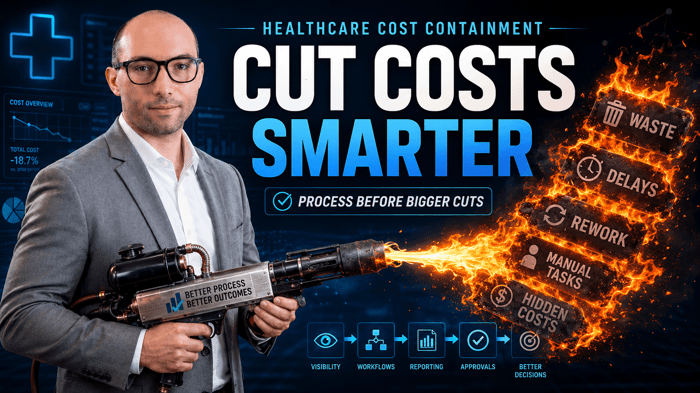
Healthcare cost containment is not just about spending less. It is about operating with better control. Leaders need to see where money is moving, why it is moving, and whether the organization can respond before waste becomes part of the normal process.
That is why better process should come before broader cuts.
If your healthcare organization is evaluating ways to improve operational visibility, financial workflows, or reporting structure, learn more about Campbell Technology Advisors’ System Selection & Implementation services.
Listen to the Related Podcast Episode
This article expands on the ideas discussed in our Beyond the Numbers podcast episode, “Healthcare Cost Containment: Control Costs Without Cutting Care.”
In the episode, Randy and Chris discuss why cost containment in healthcare should not begin with broad cuts to staffing, services, or patient care. Instead, they explain how organizations can create better financial control by improving the processes behind reporting, approvals, workflows, visibility, and operational decision-making.
Watch the full episode on YouTube, or listen on Spotify and Apple Podcasts to hear the conversation behind this topic.
What Healthcare Cost Containment Really Means
Healthcare cost containment means controlling or reducing expenses without lowering care quality, patient access, or compliance discipline.
That distinction matters.
The goal is not to starve departments, delay necessary hires indefinitely, or make one quarter look better by pushing the pain into the next one.
The goal is to remove the wrong costs.
Some costs support care. Some costs support growth. Some costs exist because the process around them is broken.
If accounts payable still runs through email chains and manual support just to move an invoice, that is not healthy overhead. If managers wait days or weeks for budget-to-actual detail, that lag costs money. If staffing decisions happen without current volume and reimbursement data in the same view, leadership is guessing.
In healthcare, guessing gets expensive quickly.
Healthcare cost containment should help leaders protect what matters while reducing the friction, waste, and rework that make the organization harder to manage.
The Close Reveals the Problem, But It Does Not Create It
Month-end close is often where cost problems become visible.
But the close does not create the problem. It reveals what already happened.
Cost decisions happen throughout the month in purchasing, payroll, scheduling, coding, accounts payable, accounts receivable, service mix, and operational planning.
By the time finance closes the books and explains the variance, the drift may have already happened.
That is why finance, reporting, and close are the scoreboard. The actual game is happening earlier.
If leaders only look at cost issues after the month closes, they are already reacting late.
This is also where trust can begin to break down.
If a physician leader cannot see what labor belongs to a service line, how supplies were allocated, where overhead landed, or what reimbursement supported the work, they may not trust the result. Then finance spends the meeting defending the source data instead of helping leadership decide what to do next.
That turns into an operating problem quickly.
Patients can feel it through delays, confusion, and affordability pressure. Clinicians can feel it through workload and burnout. Boards can feel it when cash gets tight and options become limited.
Why Healthcare Teams Stay Stuck
For many healthcare organizations, the problem is not awareness. Leaders know the process is difficult.
The problem is structure.
One major barrier is limited data transparency.
The accounting team cannot contain costs if it cannot see costs clearly enough, early enough, or at the right level. Reporting that lands after close may explain the past, but it does not always help managers catch labor drift, supply variance, or utilization changes while there is still time to act.
Another barrier is reimbursement complexity.
Busy does not always mean profitable. When payment timing is inconsistent, contract terms are hard to model, or denial trends sit outside the rest of reporting, leaders may react to volume instead of margin. A service line can look full and still move in the wrong direction financially.
A third barrier is outdated manual process.
Billing may get touched too many times. AP approvals may sit in email. Payroll entries may land late. Team members may create side files because the system cannot answer the question quickly enough.
The effort may be there, but the structure is working against the team.
When the accounting system says one thing, the EMR says another, payroll has a third view, and procurement follows its own path, reporting becomes harder than it should be.
That is when meetings can turn into debates over whose export is correct instead of conversations about what needs to happen next.
Organizations looking to improve workflow automation, reporting visibility, and operational efficiency can explore more about how Campbell Technology Advisors helps healthcare finance teams here: How We Help
Resistance to Change Is Often Protection of the Workaround
When processes are fragmented, leaders sometimes describe the issue as resistance to change.
But in many cases, people are not resisting change because they are careless. They are protecting the workaround that helped them get through the day.
A manager may have built a spreadsheet because reports were unreliable. That spreadsheet solved a short-term problem. Over time, it may start to feel safer than a promise that a new system or process will be better.
The problem is that workarounds do not scale well.
If one team is pulling labor data from payroll, another is pulling volume data from the EMR, and another is pulling purchasing detail from a separate source, the organization may still be working hard, but the process is not working well.
When department leaders need custom files just to understand where they stand, or budget-to-actual reporting arrives after the decision window has closed, that is a sign the reporting structure needs attention.
For healthcare cost containment to work, the organization needs more than effort. It needs a cleaner process and a stronger source of truth.
Where Healthcare Leaders Should Look First
Healthcare leaders should start with the levers that change how costs behave across the organization.
A line-by-line review of the profit and loss statement can be useful, but it is not enough. If the same reporting pressure shows up somewhere else next month, the organization may be treating the symptom instead of the system.
Better cost containment starts by connecting clinical, financial, and operational data so one improvement supports the next.
Utilization review is one place to look.
This should not be treated as a box-checking exercise. Leaders should look for duplicate services, avoidable procedures, weak handoffs, and care patterns that consume resources without improving outcomes.
The value is stronger when those findings connect back to cost per case, throughput, and care pathways.
Financial operations are another place to look.
Automating AP, approvals, allocations, reconciliations, and close-related tasks can reduce friction that slows the business. Managers get numbers sooner. Finance spends less time assembling data and more time helping leadership use it.
Labor analysis is also important.
When data is cleaner, leaders can compare staffing levels, patient volume, productivity, and full-time equivalents in one view. They can ask whether overtime is covering weak scheduling, whether high-cost clinicians are doing work that could shift elsewhere, or whether cross-training could remove a bottleneck.
Supply visibility matters too.
Better results often come from centralized purchasing visibility, stronger inventory controls, contract consolidation, and price variance tracking. If departments buy similar items from different vendors and nobody can see the spread, supply cost drift can happen in plain sight.
What the System Needs to Do
A stronger financial system does not need to make the organization more complicated.
It needs to do two things well.
It needs to give leaders current numbers, and it needs to remove workflow friction.
If reporting improves but approvals still bounce through inboxes, the organization still has delay. If tasks are automated but the data still lands late, leaders still have weak decision support.
The technology stack has to fit how the organization actually operates.
For healthcare organizations, that often means connecting accounting, procurement, spend management, planning, reporting, and audit controls with the systems people use every day, including EMR, payroll, and other operating platforms.
Without that connection, the organization is left with manual workflows.
Practice administrators may pull data from an EMR into Excel. Revenue, payments, or adjustments may be sent to accounting manually. Finance may then record information after the fact.
That is inefficiency at scale.
A better structure gives leaders dimensional visibility. They may need to see performance by location, department, service type, provider, CPT code, funding source, or other categories that reflect how the organization is actually managed.
That structure matters because healthcare leaders need to evaluate the business the same way they run it.
Mid-sized healthcare organizations evaluating financial systems or operational process improvements can review Campbell Technology Advisors’ System Selection & Implementation approach to better align technology with operational goals.
Start With the Outcome You Want
Healthcare leaders do not need to turn every improvement into a giant project.
The best place to start is with the outcome the organization wants most.
Some teams need more trust in the numbers. Others need more time back. Others need better efficiency, clearer visibility, or a stronger foundation for growth.
If the goal is time, the focus should be on bottlenecks. What is taking the most time? Which workflows slow the team down every month? Which manual steps create recurring cleanup?
If the goal is efficiency, the focus should be on workflow mapping. Where can low-value activities be reduced or replaced with higher-value work?
If the goal is trust, the focus should be on data structure and controls. Where does the source of truth live? How is information recorded? Is it accurate, timely, and consistent?
If the goal is clarity, the focus should be on visibility. Can leaders see performance by location, provider, service line, or department? Can they understand what is driving results without waiting for a custom spreadsheet?
If the goal is growth, the system needs to support what comes next. That may include new locations, acquisitions, expanded service lines, or more complex reporting needs.
The first win is often trust in the number.
Once trust improves, workflow changes become easier to sustain. Leaders can build a stronger monthly review rhythm around exceptions and action instead of spending every meeting debating the data.
A Practical Example of Better Cost Containment
In one example discussed on the podcast, a healthcare organization was dealing with growth, reporting pressure, and compliance demands while managing both patient revenue and grant revenue.
Before improving its financial systems and processes, the team relied heavily on Excel and stayed in reactive mode. They could not segment financials the way leadership needed, which made reporting and decision-making harder.
After moving to a stronger structure, the organization was able to manage growth more effectively while improving finance efficiency, reducing manual work, and shortening the month-end close process.
The bigger point is not just that accounting became faster.
The work changed.
Purchasing moved closer to departments with better control. Bank reconciliations became faster. Managers received budget-to-actual reporting more consistently. Reporting became easier because the data could be viewed by funding source, department, project, physician, and location.
That is what good systems and better processes are supposed to do.
They do not just speed up accounting. They give leadership a cleaner way to manage the business.
What to Inspect This Week
Healthcare cost containment does not have to start with a full transformation.
Start by choosing one process.
It could be AP approvals. It could be P&L reporting. It could be variance analysis. It could be provider margin reporting. It could be the month-end close process.
Look for the point where spreadsheet friction, lag, or unclear ownership is distorting decisions.
Where does the team keep doing cleanup?
Where does information arrive too late?
Where are approvals getting stuck?
Where does leadership lack visibility?
Where do managers create side files because the system cannot answer the question?
That is often the best place to start.
Do not try to rebuild everything at once. Find the process that repeatedly creates friction, get honest about why it happens, and improve from there.
How Campbell Technology Advisors Can Help
Campbell Technology Advisors helps healthcare organizations look at cost containment through the lens of process, visibility, and financial control.
That starts with understanding where the organization is today.
We help review workflows, reporting challenges, approval processes, data structure, system limitations, integrations, and long-term goals. From there, we help build a practical roadmap for improving the finance and operations layer of the organization.
The goal is not to cut for the sake of cutting.
The goal is to help leaders see the business more clearly, reduce manual work, improve trust in the numbers, and create a stronger foundation for better decisions.
For physician-owned practices, orthopedic groups, and healthcare organizations managing growth, reimbursement pressure, staffing challenges, and reporting demands, stronger process can be one of the most important cost containment tools available.
Ready to review your current workflow and reporting structure? Book a call with Campbell Technology Advisors
The Bottom Line
Healthcare cost containment is often framed as a spending issue.
But many cost problems start in process.
When visibility is weak, approvals are slow, reporting is delayed, and systems do not connect, leaders are forced to make decisions with incomplete information.
Better cost containment does not always start with bigger cuts.
It starts with better control.
That means cleaner data, stronger workflows, better reporting, more timely visibility, and systems that support how the organization actually operates.
If your healthcare organization is trying to control costs while still relying on spreadsheets, email approvals, delayed reporting, or disconnected systems, Campbell Technology Advisors can help you take a closer look.
Ready to strengthen your financial process? Book a call with Campbell Technology Advisors today to review where cost containment may be hiding in your workflows and build a practical roadmap for what comes next.
FAQs
What is healthcare cost containment?
Healthcare cost containment refers to strategies healthcare organizations use to control expenses while maintaining care quality, operational efficiency, and compliance.
Why do healthcare organizations struggle with cost containment?
Many organizations struggle because of disconnected systems, delayed reporting, manual workflows, weak visibility, and inefficient approval processes.
How can healthcare organizations reduce operational costs?
Organizations can improve operational efficiency by strengthening workflows, automating manual processes, improving reporting visibility, and connecting financial and operational systems.
Why is process improvement important in healthcare finance?
Better process improves visibility, reduces manual work, shortens reporting cycles, and helps leaders make faster and more informed financial decisions.
Where should healthcare leaders start?
Start with one process that creates repeated friction. AP approvals, variance analysis, P&L reporting, provider margin reporting, and month-end close are all practical places to begin.