
Table of Contents
- Orthopedic Surgeon Career Decisions: Looking Beyond Salary
- Key Takeaways
- Employment vs. Ownership
- Key Orthopedic Career Pathways
- Why ASC and Ancillary Income Matter
- Compensation Formulas Need More Scrutiny
- Partnership Buy-Ins Are Business Transactions
- Financial Visibility Is the Real Advantage
- KPIs Every Orthopedic Group Should Track
- The Back Office Is Not Just Overhead
- Questions Every Orthopedic Surgeon Should Ask
- How Campbell Helps Orthopedic Practices Gain Financial Clarity
- Frequently Asked Questions
- What should orthopedic surgeons look at besides salary?
- Is hospital employment or private practice better for orthopedic surgeons?
- Why does ASC ownership matter for orthopedic surgeons?
- Why are wRVUs not the same as profitability?
- What financial reports should an orthopedic practice review monthly?
- How can better financial visibility help an orthopedic practice?
- The Bottom Line
- FAQs
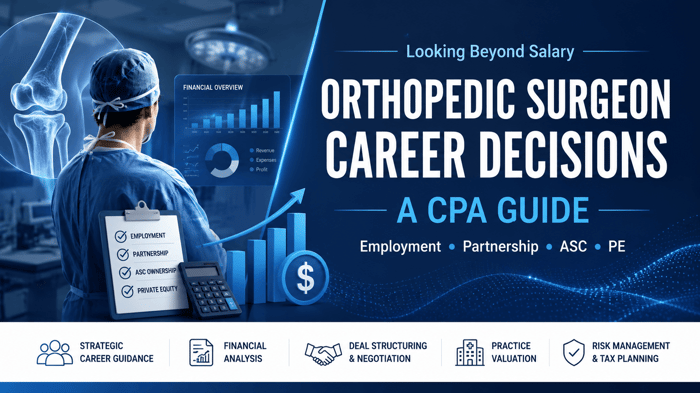
For orthopedic surgeons, career decisions are often framed around compensation. But from a CPA and advisory perspective, salary is only one part of the equation. The more important question is: what economic model are you entering?
Orthopedic surgeon career decisions require more than comparing compensation packages because each pathway creates a different mix of risk, control, ownership, tax exposure, and long-term financial opportunity.
A hospital-employed role, private group partnership track, independent practice, ASC ownership opportunity, or private equity-backed platform can each create very different financial outcomes. The clinical work may look similar, but the business structure underneath can change everything.
Each path carries a different mix of income predictability, ownership upside, tax exposure, business risk, administrative burden, and long-term wealth potential. For surgeons making major career decisions, understanding those differences is critical.
Orthopedic Surgeon Career Decisions: Looking Beyond Salary
A high salary does not always mean a strong financial opportunity.
Many surgeons compare opportunities based on guaranteed compensation. That is understandable. A higher starting salary is easy to measure, easy to compare, and often feels like the safest choice.
But two offers with similar salaries can lead to very different long-term outcomes.
One opportunity may offer more immediate income but little ownership upside. Another may start lower but provide a clearer path to partnership, ASC ownership, ancillary income, or future transaction value.
One practice may have strong reporting and clean overhead allocation. Another may have weak collections, unclear financial statements, or a compensation model that is difficult to verify.
From a CPA perspective, the question is not simply, “What will I earn this year?”
The better question is, “What financial model am I stepping into, and how will it affect my income, risk, control, taxes, and wealth-building potential over time?”
Key Takeaways
Orthopedic surgeons should evaluate opportunities by looking beyond base salary.
Employment, partnership, private practice, ASC ownership, and private equity-backed models each come with different levels of control, risk, tax impact, and long-term financial opportunity.
The strongest decisions come from understanding compensation formulas, ownership rights, overhead allocation, revenue-cycle performance, and financial reporting quality before signing a contract or buying into a practice.
Employment vs. Ownership
The first major divide is employment versus ownership.
In an employment model, the surgeon’s economics are mostly defined by a contract. Compensation may include a guaranteed salary, wRVU-based production, quality incentives, call pay, bonuses, benefits, malpractice coverage, and retirement contributions.
This model can provide stability and infrastructure, especially inside a hospital or health system. The tradeoff is that many strategic decisions are usually controlled elsewhere. Staffing, OR access, site strategy, payer contracting, ancillary revenue, and capital allocation may sit with the employer.
In an ownership model, the surgeon is exposed to a different set of economics. Income may include practice profits, partner distributions, ASC and/or pharmacy income, imaging or physical therapy revenue, real estate interests, and potential transaction value.
That upside comes with more complexity. Owners need to understand collections, overhead, accounts receivable, buy-ins, buy-outs, debt, capital calls, tax planning, partner compensation formulas, and compliance risk.
Neither model is automatically better. The key is understanding what is being traded away and what is being gained.
Key Orthopedic Career Pathways
A hospital-employed orthopedic surgeon usually receives the most predictable compensation and the lowest direct business risk. The hospital funds the enterprise, provides infrastructure, and absorbs much of the administrative burden. This can be attractive for surgeons who value stability and lower operational responsibility.
However, the long-term ownership upside is usually limited. The surgeon may have less control over staffing, scheduling, ancillary economics, and strategic direction.
An employed surgeon in a private orthopedic group often sits in the middle. They may receive more practice-level visibility than a hospital-employed physician and may have a clearer future path to partnership. But until ownership occurs, the surgeon is still primarily monetizing labor rather than capital.
A partner-track physician in an independent group has the potential for a more meaningful economic shift. The early years may look like employment, but the long-term opportunity may include owner-level cash flow, governance rights, and participation in future growth.
This can be a strong path, but only if the partnership terms are clear, documented, and supported by reliable financial reporting.
A founder or co-founder of a new private practice has the highest autonomy and often the highest long-term upside. But this path also carries the most risk. Before collections arrive, the practice must fund payroll, rent, malpractice, software, billing infrastructure, credentialing delays, equipment, marketing, and administrative support.
From a CPA standpoint, starting a practice is not just a career move. It is a business launch.
A physician owner considering private equity is making another type of decision. They may be converting future practice cash flow into upfront liquidity, rollover equity, and a different operating structure. That can create significant wealth, but it also changes control, governance, compensation, and future upside.
A surgeon joining a private equity-backed platform later is in a different position than the original sellers. The platform may offer infrastructure, scale, and administrative support, but the largest first transaction benefit may have already gone to the founding physicians.
In this scenario, the key questions are: What portion of the economics is salary? What portion is equity? What rights come with that equity? And who controls the decisions that affect future value?
Why ASC and Ancillary Income Matter
Ambulatory surgery center ownership can materially change the financial model for orthopedic surgeons.
Without ASC ownership, the surgeon is generally paid for professional services. With ASC ownership, the surgeon may also participate in facility-level profits through distributions based on ownership percentage.
ASC ownership can give physicians more control over the surgical environment, staffing, scheduling, patient experience, and site-of-service economics. In orthopedics, where many procedures have shifted toward outpatient settings, ASC economics can be especially important.
However, ASC ownership should be evaluated like a real investment. A surgeon should understand case volume, payer mix, reimbursement rates, implant costs, anesthesia relationships, debt service, governance rights, distribution policy, compliance structure, and capital requirements.
Ancillary services can also play a major role in orthopedic practice economics. Imaging, physical therapy, durable medical equipment, injections, pain management, and real estate can all improve margin when structured and managed properly.
But ancillary revenue is not automatically good revenue.
Each ancillary line should be treated like its own mini-business. The practice should understand revenue, direct costs, staffing, compliance requirements, overhead allocation, and return on capital.
From a CPA perspective, the question is not simply, “Do we have ancillaries?” The better question is, “Are these ancillaries profitable, compliant, and fairly allocated among the physicians?” That is where Campbell Technology Advisors and Campbell and Company CPAs can help.
Compensation Formulas Need More Scrutiny
Orthopedic compensation often includes some combination of base salary, wRVU production, collections, call pay, quality incentives, bonuses, and benefits.
The mistake many young surgeons make is focusing on the headline number without understanding the formula behind it.
A high guaranteed salary may look attractive, but it may come with unrealistic productivity expectations, limited support, weak OR access, or restrictive contract terms. A collections-based model may offer upside, but only if billing, payer mix, denial management, and patient collections are strong.
A wRVU model may reward production, but wRVUs are not the same as profit.
Before signing, a surgeon should understand:
- How compensation is calculated
- What happens after the guarantee period
- Which production thresholds apply
- Who controls staffing and scheduling support
- Whether productivity and collections data will be available
- How overhead is allocated
- What happens if the contract terminates
- Whether future partnership rights are documented
A compensation offer is only as strong as the system behind it.
Partnership Buy-Ins Are Business Transactions
A partnership offer should not be treated as a vague career milestone. It is a financial transaction.
A buy-in may involve tangible assets, accounts receivable, goodwill, ASC interests, ancillary assets, real estate, or some combination of those components. Among other structures, you may participate in a direct purchase, a financed buy-in, or a phased reduction in compensation over several years.
Each structure has different tax, cash flow, and risk implications.
The surgeon should know exactly what they are buying, how the value was determined, what rights they receive, when distributions begin, how voting works, and what happens when they eventually leave.
The buy-out terms matter just as much. A group without a clear buy-sell agreement may be carrying hidden risk. Future disputes over retirement, disability, termination, death, valuation, or partner exits can create serious financial and legal problems.
Strong practices address those issues before they become urgent.
Financial Visibility Is the Real Advantage
One of the biggest problems in physician practices is the gap between clinical activity and financial performance.
A surgeon may feel extremely busy. The clinic may be full. Surgeries may be booked. wRVUs may be high. But that does not necessarily mean the practice is generating strong cash flow or partner-level profit.
Busyness lives in the EMR. Profit lives in the connection between clinical activity, billing quality, reimbursement, cost structure, and cash conversion.
That is why orthopedic practices need more than basic bookkeeping. They need financial visibility.
A strong monthly reporting package should help answer questions such as:
- Is production turning into collections?
- Are denials or AR aging increasing?
- Which providers are generating contribution margin?
- Which locations are profitable?
- Are ASC distributions supported by actual performance?
- Are partner distributions supported by cash flow?
- Is overhead being allocated fairly?
- Are ancillaries adding value or just complexity?
Without that level of visibility, physicians may be making major career and ownership decisions based on incomplete information.
KPIs Every Orthopedic Group Should Track
For orthopedic groups, the right key performance indicators can reveal whether clinical production is turning into actual financial performance.
Important metrics include net collections, net collection rate, days in accounts receivable, AR over 90 days, denial rate, clean claim rate, contractual adjustment rate, bad debt, patient responsibility collections, visits, surgeries, wRVUs, revenue per provider, revenue per visit, revenue per surgical case, overhead per provider, EBITDA, physician compensation as a percentage of collections, ASC case volume and distributions, cash on hand, debt service coverage, and partner distributions.
These metrics help explain why two surgeons with similar production can generate very different economics. Differences in payer mix, denial rates, staffing, location costs, surgical mix, and overhead allocation can materially affect profitability.
A good practice does not just produce financial statements. It produces information physicians can actually use.
The Back Office Is Not Just Overhead
In a high-performing orthopedic practice, the back office is not simply an administrative cost. It is the infrastructure that turns clinical work into collectible revenue, reliable reporting, compliant compensation, and credible owner distributions.
Accounting, payroll, billing coordination, revenue-cycle oversight, accounts payable, budgeting, tax planning, dashboarding, internal controls, system integration, and physician compensation reporting all affect the economics of the practice.
When the back office is weak, predictable problems appear. The monthly close runs late. Spreadsheets multiply. EMR data does not reconcile to accounting data. Physician compensation becomes difficult to explain. Overhead allocation becomes political. ASC economics remain unclear. Cash forecasts become unreliable. Partner trust begins to erode.
When the back office is strong, physicians can make better decisions with cleaner information.
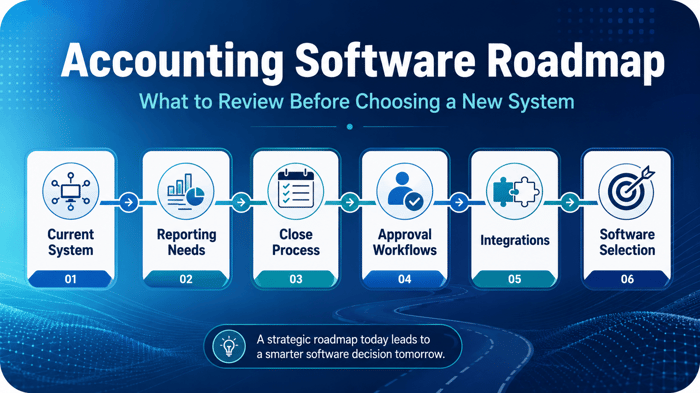
For practices evaluating whether their current systems can support growth, an accounting software roadmap can help clarify what to review before making a change.
That is where advisory, accounting, and technology support become valuable. Practices need systems that connect clinical activity, billing data, accounting data, provider reporting, and operational dashboards into one reliable decision-making structure.
Questions Every Orthopedic Surgeon Should Ask
Before signing an employment agreement, a surgeon should ask how pay is calculated, what support is guaranteed, what restrictive covenants apply, who pays malpractice tail, and whether any future partnership opportunity is documented.
Before joining a private group, they should ask to review financial statements, payer mix, revenue-cycle trends, overhead methodology, provider productivity, ancillary economics, and historical partnership outcomes.
Before buying into partnership, they should ask what they are actually buying, how the value was calculated, how distributions work, what governance rights they receive, and how the buy-out works later.
Before investing in an ASC, they should evaluate case volume, payer mix, implant costs, debt terms, governance, compliance, and distribution policy.
Before agreeing to a private equity transaction, they should understand the transaction structure, cash versus rollover equity, voting rights, dilution risk, compensation changes, debt, management fees, and post-close control.
These are not just legal questions. They are accounting, tax, finance, and operational questions.
How Campbell Helps Orthopedic Practices Gain Financial Clarity
Orthopedic groups need more than basic bookkeeping. They need financial systems that connect clinical activity, revenue cycle, accounting, provider profitability, ASC performance, and cash flow into one reliable reporting structure.
The right healthcare accounting system can make it easier to track provider profitability, revenue-cycle trends, ASC performance, and practice-level financial visibility.
Campbell Technology Advisors and Campbell & Company help healthcare practices improve financial visibility through accounting system design, QuickBooks and Sage Intacct support, EMR-to-accounting integration strategy, dashboard reporting, provider profitability analysis, allocation methodology, cash-flow planning, and advisory support.
For orthopedic groups evaluating growth, partnership structures, ASC expansion, compensation models, or private equity readiness, better financial visibility can turn complex decisions into measurable economic models.
Practices that are unsure where better financial visibility could create the greatest return can use Campbell Technology Advisors’ ROI Calculator to estimate the potential impact of better systems, cleaner reporting, reduced manual work, and improved decision-making.
For firms advising on orthopedic surgeon career decisions, clean financial reporting can turn complex choices into measurable business comparisons.
Practices that want stronger reporting should also evaluate whether their accounting systems, dashboards, and physician allocation workflows are giving physicians the visibility they need to make confident decisions.
Frequently Asked Questions
What should orthopedic surgeons look at besides salary?
Orthopedic surgeons should evaluate compensation structure, ownership rights, partnership terms, ASC opportunities, ancillary income, overhead allocation, payer mix, revenue-cycle performance, and financial reporting quality.
Is hospital employment or private practice better for orthopedic surgeons?
Neither model is automatically better. Hospital employment may offer more stability and less direct business risk, while private practice or partnership may offer more control, ownership upside, and long-term wealth-building potential.
Why does ASC ownership matter for orthopedic surgeons?
ASC ownership can allow surgeons to participate in facility-level profits, not just professional fees. However, it should be evaluated carefully based on case volume, payer mix, debt, governance, compliance, and distribution policy.
Why are wRVUs not the same as profitability?
wRVUs measure production, but they do not show whether the work is turning into collections, margin, or cash flow. Two surgeons with similar wRVUs can produce very different financial outcomes depending on payer mix, denials, overhead, and site-of-service economics.
What financial reports should an orthopedic practice review monthly?
Orthopedic practices should review income statements, balance sheets, cash flow, provider profitability, location profitability, revenue-cycle metrics, ASC distributions, budget versus actual results, and cash-flow forecasts.
How can better financial visibility help an orthopedic practice?
Better financial visibility helps practices understand whether growth is actually creating profit. It can also support better orthopedic surgeon career decisions around compensation, partnership, ASC expansion, ancillary services, private equity readiness, and long-term strategy.
The Bottom Line
Orthopedic surgeon career decisions should not be made from headline compensation alone.
Orthopedic surgeons spend years developing clinical judgment. But in today’s market, financial judgment is becoming just as important to long-term career success.
The surgeon who understands only the clinical side can still build a strong career. But the surgeon who understands compensation, ownership, ASC economics, ancillaries, overhead, taxes, revenue cycle, and practice reporting has a much clearer advantage.
Financial visibility allows surgeons to compare career paths based on evidence rather than assumptions. It helps them understand the difference between a good salary and a good economic model. It helps them identify when a partnership track is real, when a buy-in is fair, when an ASC opportunity is meaningful, and when a private equity offer carries more risk than it first appears.
The best orthopedic surgeon career decisions are made with clear numbers, strong reporting, and a complete understanding of the business model behind each opportunity.
In a changing orthopedic market, the best decisions are made from clear numbers, strong reporting, and the right advisory team.
Ready to improve financial visibility in your practice? Contact Campbell Technology Advisors and Campbell & Company to start the conversation.
Disclaimer: This article is for informational purposes only and should not be treated as legal, tax, valuation, or investment advice. Orthopedic surgeons and physician groups should consult qualified legal, tax, and healthcare advisors before making employment, ownership, ASC, or transaction decisions.
FAQs
What should orthopedic surgeons look at besides salary?
Orthopedic surgeons should evaluate compensation structure, ownership rights, partnership terms, ASC opportunities, ancillary income, overhead allocation, payer mix, revenue-cycle performance, and financial reporting quality.
Is hospital employment or private practice better for orthopedic surgeons?
Neither model is automatically better. Hospital employment may offer more stability and less direct business risk, while private practice or partnership may offer more control, ownership upside, and long-term wealth-building potential.
Why does ASC ownership matter for orthopedic surgeons?
ASC ownership can allow surgeons to participate in facility-level profits, not just professional fees. However, it should be evaluated carefully based on case volume, payer mix, debt, governance, compliance, and distribution policy.
Why are wRVUs not the same as profitability?
wRVUs measure production, but they do not show whether the work is turning into collections, margin, or cash flow. Two surgeons with similar wRVUs can produce very different financial outcomes depending on payer mix, denials, overhead, and site-of-service economics.
What financial reports should an orthopedic practice review monthly?
Orthopedic practices should review income statements, balance sheets, cash flow, provider profitability, location profitability, revenue-cycle metrics, ASC distributions, budget versus actual results, and cash-flow forecasts.
How can better financial visibility help an orthopedic practice?
Better financial visibility helps practices understand whether growth is actually creating profit. It can also support better decisions around compensation, partnership, ASC expansion, ancillary services, private equity readiness, and long-term strategy.