
Table of Contents
- Why Software Selection Should Start With an Accounting Software Roadmap
- Review the Current Accounting Process
- Identify Reporting Gaps
- Evaluate the Month-End Close Process
- Review Approval Workflows and Controls
- Clean Up the Chart of Accounts
- Map Integrations and Connected Systems
- Think About Future Growth
- Avoid Rebuilding Old Problems in a New System
- What an Accounting Software Roadmap Should Include
- How an Advisor Can Help Build the Roadmap
- The Bottom Line
- FAQs
Why Software Selection Should Start With an Accounting Software Roadmap
An accounting software roadmap helps organizations review their current process, reporting needs, workflows, integrations, and growth plans before choosing a new system.
Choosing new accounting software is a major decision, but the software itself should not be the first step.
For many organizations, the conversation starts when the finance team begins feeling pressure. Reports take too long. Month-end close becomes harder to manage. Approvals happen through email. Spreadsheets carry too much of the process. Leadership wants better visibility, but the finance team has to work around the system to provide it.
At that point, it may be clear that the current accounting system is no longer supporting the organization the way it should.
But moving too quickly into software demos can create another problem.
A system may look impressive during a presentation, but if the organization has not reviewed its current process, reporting needs, approval workflows, integrations, data structure, and long-term goals, it can be difficult to know whether that system is actually the right fit.
That is why an accounting software roadmap matters.
The goal is not just to choose new software. The goal is to understand what the finance team needs, where the current process is falling short, and what the next system must support.
Review the Current Accounting Process
Before choosing a new system, organizations should review how the accounting process works today.
That means looking at the full flow of financial activity, from transaction entry to reporting.
This may include accounts payable, accounts receivable, reconciliations, approvals, expense management, billing, cash management, consolidations, and month-end close.
The goal is to identify where the process is working, where it is slowing down, and where manual steps are creating risk.
In many organizations, the finance team has built workarounds over time. A spreadsheet may have started as a temporary fix. An email approval process may have been created because it was faster at the time. A manual report may have become part of the monthly routine because the system could not produce it cleanly.
Those workarounds may solve short-term problems, but they can become harder to manage as the organization grows.
A roadmap helps separate what should be kept, what should be improved, and what should be redesigned before moving into a new system.
Identify Reporting Gaps
Reporting is one of the most important areas to review before selecting accounting software.
For many growing organizations, reporting is where system limitations show up first.
The finance team may need to export data, clean it, combine spreadsheets, and rebuild reports every month. Leadership may want financial performance by entity, department, location, program, grant, provider, project, customer, or service line. Board members or lenders may expect clearer reporting packages. Department leaders may need better budget visibility.
If the current system cannot support those needs efficiently, the finance team becomes the reporting bottleneck.
An accounting software roadmap should identify the reports the organization needs now and the reports it expects to need in the future.
That may include monthly financial statements, budget-to-actual reports, cash flow reporting, department-level reporting, multi-entity reporting, dashboard views, and custom reports leadership relies on.
The better the organization understands its reporting needs before software selection, the easier it becomes to evaluate which system can support those needs.
Evaluate the Month-End Close Process
Month-end close is another area that should be reviewed before choosing a new accounting system.
A slow or stressful close process is often a sign that the system, workflow, or data structure is not aligned with the organization’s needs.
The finance team may be waiting on approvals, reconciling information from multiple sources, checking spreadsheets, manually tracking tasks, or following up through email.
A stronger system can support a more organized close process, but software alone does not fix a broken workflow.
The roadmap should review each step in the close process.
What needs to happen?
Who is responsible?
Where do delays happen?
Which tasks are manual?
Which approvals are required?
Which reports are needed before the close can be finalized?
This helps the organization understand whether the issue is software, process, staffing, data quality, or a combination of factors.
The goal is not only to close faster. The goal is to close with better accuracy, visibility, and confidence.
Review Approval Workflows and Controls
Approvals are another common area where growing organizations begin to feel strain.
When approvals happen through email, chat, or spreadsheets, it can be difficult to see who approved something, when it was approved, and whether the right process was followed.
That creates risk for the finance team and for leadership.
A roadmap should review approval workflows across the organization. That may include vendor bills, purchase requests, expense reimbursements, journal entries, budget changes, and payment approvals.
The organization should understand which approvals are required, who needs to be involved, and where the process should be more structured.
This is especially important for organizations with multiple departments, locations, entities, or programs.
A new system should support stronger controls, but those controls need to be designed intentionally. If the approval process is unclear before implementation, the new system may simply recreate the same confusion in a different platform.
Clean Up the Chart of Accounts
The chart of accounts is one of the most important parts of any accounting system.
If it is too limited, reporting becomes difficult. If it is too detailed, the finance team may end up managing unnecessary complexity.
Before moving into a new system, organizations should review whether the current chart of accounts still supports the way the business operates.
Over time, accounts may be added for one-time needs. Departments may change. New entities may be created. Reporting requirements may expand. What worked years ago may no longer make sense today.
A roadmap should help determine whether the chart of accounts needs to be cleaned up, simplified, expanded, or redesigned.
The goal is to create a structure that supports reporting without making the system harder to manage.
This is also where organizations should think carefully about dimensions, entities, departments, locations, projects, programs, grants, service lines, or other reporting categories.
The right structure can make reporting much easier. The wrong structure can create years of unnecessary manual work.
Map Integrations and Connected Systems
Most accounting systems do not operate alone.
They may connect with payroll, banking, billing, expense management, CRM, inventory, donor management, project management, payment processing, reporting tools, or other operational systems.
Before choosing new accounting software, organizations should map the systems that currently connect to finance.
This helps identify which integrations are still needed, which ones are outdated, and which processes may need to change.
It also helps avoid surprises during implementation.
Some integrations may be critical. Others may have been built years ago and no longer serve the organization well. Some data may need to move into the accounting system. Other data may be better managed in a separate platform.
A roadmap helps the team understand what information needs to flow between systems and why.
That makes software selection more practical because the organization can evaluate whether a system supports the right connections.
Think About Future Growth
A new accounting system should support where the organization is going, not just where it is today.
That means the roadmap should consider future growth.
Will the organization add more entities?
Will it expand into new locations?
Will reporting needs become more detailed?
Will leadership need better dashboards?
Will the finance team need stronger controls?
Will the organization need more users, more approval paths, or more integrations?
Will the system need to support more complex billing, revenue recognition, grants, projects, or service lines?
These questions matter because switching systems is not something most organizations want to do repeatedly.
The goal is to choose a system that can support the next stage of growth without forcing the finance team to rely on more manual work every year.
Scalability is not only about adding users. It is about whether the system can support more complexity while keeping financial data clean, useful, and controlled.
Avoid Rebuilding Old Problems in a New System
One of the biggest risks in any accounting software project is recreating the old process inside the new system.
This happens when implementation starts before the organization has reviewed what needs to change.
If the current process is too manual, the new system should not simply copy that process.
If reporting is difficult, the new system should be designed around better reporting.
If approvals are unclear, the new system should help create a more structured workflow.
If the chart of accounts has become messy, the move should be used as an opportunity to clean it up.
A roadmap helps prevent the organization from carrying old problems into a new platform.
It gives the team a chance to step back and ask what the process should look like, not just how to move the existing setup into another system.
What an Accounting Software Roadmap Should Include
A practical accounting software roadmap should give leadership a clear view of the current state and the future state.
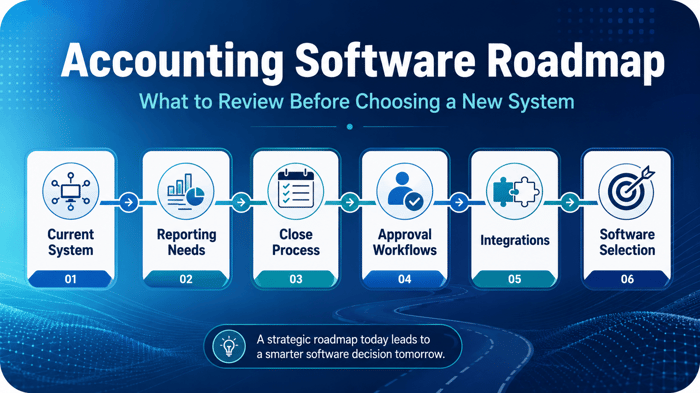
It should include a review of the current accounting process, reporting needs, month-end close, approval workflows, chart of accounts, integrations, data quality, user needs, and long-term goals.
It should also identify the biggest gaps.
Those gaps may include delayed reporting, manual consolidations, spreadsheet-heavy workflows, weak approval visibility, disconnected systems, limited financial dashboards, or a system that cannot support multi-entity reporting.
Once those gaps are clear, the organization can define what the next system needs to support.
That creates a stronger foundation for software selection, implementation planning, and long-term success.
How an Advisor Can Help Build the Roadmap
An outside advisor can help organizations take a practical, objective look at their accounting system and finance process.
That starts with understanding where the organization is today.
An advisor can review current workflows, reporting challenges, approval processes, system limitations, data structure, integrations, and long-term goals. From there, the organization can build a roadmap that supports a better software selection and implementation process.
The goal is not to choose a system before the organization understands its needs.
The goal is to help leadership make a more informed decision, avoid unnecessary complexity, and build a financial system that supports the organization’s next stage of growth.
At Campbell Technology Advisors, we help organizations review their current accounting environment, identify process gaps, and build a practical roadmap for the right next step.
For organizations considering a move to Sage Intacct or evaluating broader accounting system options, a roadmap can help create a clearer path forward.
The Bottom Line
Choosing accounting software should not start with a demo.
It should start with a roadmap.
Before selecting a new system, organizations should understand their current process, reporting gaps, approval workflows, close challenges, chart of accounts, integrations, data quality, and future growth needs.
That planning makes the software decision stronger.
It also helps reduce the risk of bringing old problems into a new system.
The right accounting platform should support better reporting, cleaner processes, stronger controls, and better visibility for leadership.
But the best results usually come when the system is selected and designed around how the organization actually needs to operate.
If your organization is evaluating accounting software or preparing for a system upgrade, Campbell Technology Advisors can help you review your current process and build a practical roadmap for the right next step.
Ready to take a closer look? Book a call with Campbell Technology Advisors today to start planning your next accounting system decision with more clarity and confidence.
FAQs
What is an accounting software roadmap?
An accounting software roadmap is a planning process that helps an organization review its current accounting system, workflows, reporting needs, approval processes, integrations, data structure, and long-term goals before selecting or implementing new software.
Why should software selection start with a roadmap?
A roadmap helps the organization understand what it actually needs before comparing software options. This makes it easier to evaluate systems based on business fit instead of relying only on demos, features, or vendor presentations.
What should be reviewed before choosing new accounting software?
Organizations should review their accounting process, reporting needs, month-end close, approval workflows, chart of accounts, integrations, data quality, user needs, and future growth plans before choosing a new system.
When should an organization consider upgrading its accounting software?
An organization may want to consider an upgrade when reporting takes too long, spreadsheets are doing too much of the work, month-end close is delayed, approvals happen outside the system, or leadership needs better financial visibility.
How does a roadmap help with implementation?
A roadmap helps identify what should be migrated, what should be cleaned up, and what should be redesigned before implementation begins. This can help reduce confusion, improve planning, and avoid bringing old problems into a new system.